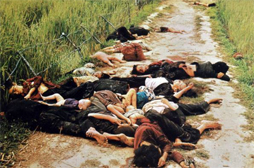
“Just following orders.” – My Lai
EPISODE: #06-25 TIME: 00:15:00
DATE: 3/1/2025
————-
Transcript Words: 1,278
“You can’t fix a nation that can’t admit what it broke.”
Orders are given in the real world, not the courtroom. And in the real world… people obey authority. Even when they shouldn’t. Even when they know they shouldn’t. Tonight, we’re stepping into a topic that sits at the crossroads of law, morality, and human nature — and at the center of a political storm we’re all feeling. Because recently, six elected members of Congress — all with strong military backgrounds — released a public service announcement urging our military and federal officials to refuse unlawful orders.
On its surface, the PSA message sounds noble. Patriotic. Even reassuring. But beneath it lies a contradiction so deep, so quietly dangerous, that very few people stop to examine it. The PSA points to principle. The real world points to punishment. And in between Those two poles stands the individual — alone. That’s what we’re talking about tonight.
Headline— What the PSA Says… and Doesn’t Say
That PSA was built around a simple legal truth: Under the Uniform Code of Military Justice — Articles 90, 91, and 92 — service members must obey lawful orders, and must refuse unlawful ones. It’s presented as straightforward. Clear-cut. Almost easy. But the UCMJ doesn’t make it easy. It doesn’t provide a list of unlawful orders. It doesn’t offer examples. It doesn’t hand anyone a laminated card with the rules spelled out. Instead, it uses a single phrase: “Manifestly unlawful.” That phrase is doing a lot of heavy lifting.
In military law, an order is presumed lawful unless the illegality is so obvious, so blatant, that any reasonable person should recognize it immediately. That’s the standard. That’s the bar. And it’s a bar so high that even experienced commanders struggle with it. Now, here’s where the contradiction emerges:
Congress — the very body asking soldiers to refuse unlawful orders — can’t even agree among itself on what “unlawful” means. They don’t agree on war powers. They don’t agree on border authority. They don’t agree on executive power. They don’t even agree on the meaning of constitutional limits anymore. And yet they expect the nineteen-year-old private… the twenty-two-year-old corporal… the junior intelligence analyst… to make that determination alone, in real time, under threat of punishment.
This is not clarity. It’s a shifting minefield disguised as moral guidance.
Headline — The Reality for the Individual in Uniform
Let’s talk about what actually happens when a service member refuses an order — even with the best intentions, even with moral clarity, even if they will later be proven right. The moment they refuse, the machinery activates. Immediate confrontation with superiors. Accusations of insubordination. Removal from duty. Reprimands. Article 15 proceedings. Risk of court-martial. Loss of rank. Loss of pay. Loss of pension. Loss of career. And all of this happens before anyone decides whether the order was truly unlawful.
There is no “pause” button. No special protection for doing the right thing. No guarantee of a fair hearing before the punishment begins. Refusal is punished instantly. Vindication — if it comes at all — arrives months or years later.
That is the truth no PSA will say out loud. There is no safe refusal. Only justified or unjustified refusal — judged long after the consequences have already reshaped someone’s life.
Headline — The Civilian Parallel: When Authority Acts Immediately
Now let’s leave the military for a moment, and look at civilian life — because the pattern is the same. Think about wrongful detentions. Mistaken arrests. Suspicion-based stops gone wrong. Situations where law enforcement acts first and sorts out legality later. A person can lose two days of freedom — or two weeks — because an officer misread a situation, or relied on a faulty report, or made a judgment call under stress. And during that time? Legality is irrelevant. Your innocence is irrelevant. Your constitutional rights are irrelevant. You sit in a cell. You lose work. You lose money. You lose reputation. You lose peace.
And even if the charge is dropped, or the judge says it never should’ve happened, or the officer admits the mistake… the system shrugs, and moves on. You don’t. Sure, most similar situations allow for maybe some civil recourse when legal accountability fails.. But it’s you that has to pursue it. This is how power functions in America: Authority acts instantly. Justice catches up eventually.
And in that gap — the individual pays the price. That’s why civilians comply. That’s why they nod, avoid eye contact, sign the form, pay the fee, swallow the insult. Because the calculation is brutally simple: “I might be right… but I’m going to lose anyway.”
Headline — The Moral Core: The Burden of Proof Kills Defiance
And this brings us to the heart of tonight’s episode. The quiet truth beneath both military and civilian life, the truth that institutions never acknowledge, the truth buried beneath slogans like “Do the right thing” and “Stand up for your rights.” Here it is:
The morality of defiance collapses under the burden of proving you were right.
You may have the moral high ground. You may be acting out of conscience. You may be correct in every sense that matters. But morality is immediate. Conscience is instantaneous.
Proof? Proof lives in paperwork. Legality lives in process. Justice lives on a timeline disconnected from the moment of crisis. And by the time the system sorts it out… your life may already be changed, yor career altered, your finances drained, your freedom jeopardized, your reputation scarred.
You win the argument after losing everything the argument was meant to protect. This is the structural flaw no PSA can paper over.
Headline — The PSA’s Argument That Isn’t an Argument
So where does that leave the PSA from those six members of Congress? It is legally correct. It is morally appealing. But operationally — it is hollow… depending on your rank. Admirals and generals fair a bit better on defense because largely they are a distance from the actual conditions that spawned the defiance; they didn’t actually pull the trigger. Any person less than that? It demands courage without offering protection. It shifts responsibility downward while refusing to clarify the law upward. It praises the lone resister while abandoning them to the consequences of resistance. Congress cannot define unlawful orders among themselves, yet they instruct the private to define it in the moment. They cannot agree on what is moral at the institutional level, yet they expect perfect moral clarity at the individual level.
Their message sounds like an argument. But when you examine it? It’s no argument at all. It’s symbolism, not support. Aspiration, not guidance. Principle, not policy. And the people asked to bear the weight of it are the ones with the least power to do anything about it.
Headline — Where Does This Leave America?
So what does all this mean for us — as a country, as citizens, as people living inside systems with enormous power and imperfect accountability? We can’t change human nature. We can’t change the psychology of obedience. We can’t change the fact that authority acts instantly while justice moves at its own pace.
But we can at least tell the truth: America depends on individuals making impossible choices inside structures not designed to protect them for making the right one.
And maybe — if we stop pretending these choices are simple, and start acknowledging the complexity and the stakes — we can begin building institutions that match the moral burden we keep placing on ordinary men and women.
Until then? The law, the order, and the burden of proof will continue to collide — and ordinary people will continue to pay the cost…. and courage continues to be with sacrifice.
Thanks for walking with me tonight.